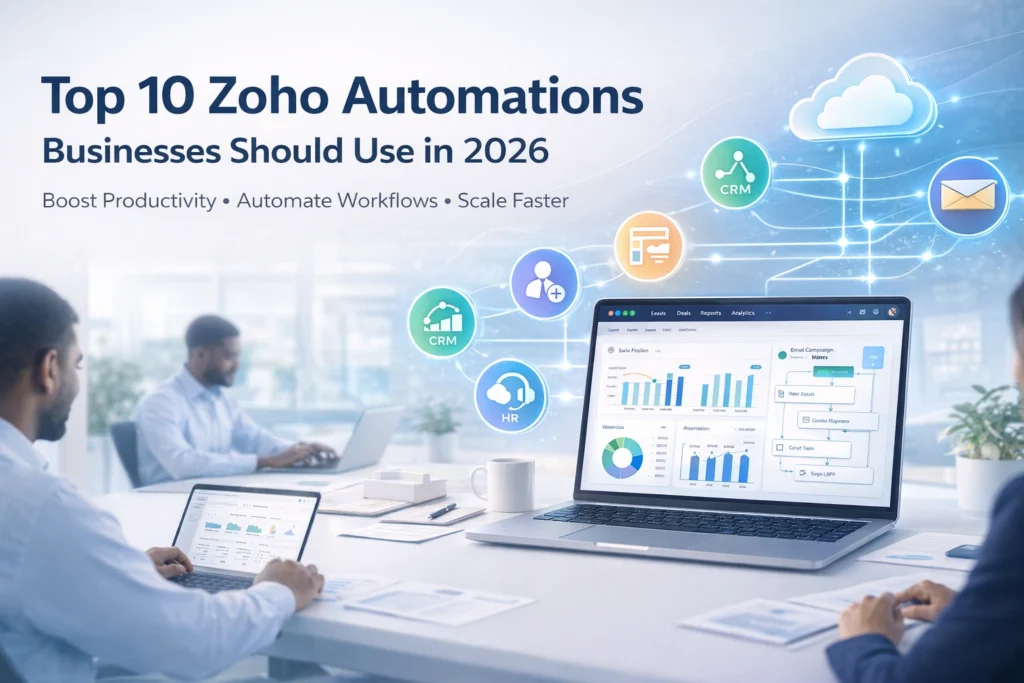
Many businesses still spend hours every day on repetitive tasks like updating customer data, sending follow-up emails, and managing leads. These manual processes slow down teams, increase the chance of errors, and reduce productivity. As companies grow, handling these tasks without automation becomes even more difficult.
This is where Zoho automation for business becomes essential. Zoho offers powerful tools that help companies automate routine tasks, connect different applications, and streamline operations.
By using Zoho’s innovative and latest tools, businesses can save time, improve accuracy, and focus more on strategy, growth, and customer relationships.
In this article, we will explore the top Zoho automations businesses should use in 2026, including industry use cases, AI-powered automation, and future automation trends.
What is Zoho Automation?
Zoho automation refers to using Zoho tools to automatically perform tasks that normally require manual work. Businesses can create workflows that trigger actions when certain events happen.
For example:
- When a new lead enters the CRM, it is automatically assigned to a sales representative.
- When a deal is closed, a project is created automatically.
- When an invoice is due, payment reminders are sent automatically.
Using tools like Zoho CRM automation, Zoho Flow automation, Zoho Creator, and Zoho Books, businesses can automate many processes easily.
Key Benefits of Zoho Automation
- Reduces manual work
- Saves time for employees
- Improves data accuracy
- Increases productivity
- Helps businesses scale faster
Why Businesses Need Automation in 2026
Modern businesses handle large amounts of customer data, leads, and transactions every day. Managing these processes manually is inefficient and costly.
Here are the key reasons automation is becoming essential:
- Businesses receive large numbers of leads daily
- Teams work across multiple platforms
- Customers expect faster responses
- Companies want to reduce operational costs
- Businesses want smarter data-driven decisions
Using Zoho business automation tools allows companies to manage these challenges effectively.
Top Zoho Automations Businesses Should Use
Automation helps businesses reduce manual work, improve efficiency, and manage operations more effectively. Below are some of the most useful Zoho automations that businesses can implement to streamline workflows and boost productivity.
1. Automated Lead Management
Managing leads manually can slow down sales teams and cause missed opportunities. Automated lead management ensures leads are captured, organized, and assigned quickly.
Automated lead management helps businesses capture, organize, and assign leads without manual effort.
How it works
A lead submits a form on the website.
The lead automatically enters Zoho CRM.
The system assigns the lead to the right salesperson.
A follow-up task is created automatically.
Benefits
Faster response time
Better lead tracking
Improved sales performance
2. Automated Email Follow-Ups
Following up with potential customers is important for converting leads into sales. Email automation ensures businesses stay connected with prospects at the right time.
Many sales opportunities are lost because businesses forget to follow up with potential customers.
Using Zoho email automation, companies can send automated follow-up emails.
Examples:
Welcome emails for new leads
Follow-up emails after meetings
Product information emails
Promotional campaigns
This helps nurture leads and increase conversion rates.
3. Customer Onboarding Automation
A smooth onboarding process helps create a positive experience for new customers. Automation ensures that onboarding steps are completed quickly and consistently.
Customer onboarding involves multiple steps that can easily be automated.
Automation can:
Send welcome emails
Create onboarding tasks
Assign account managers
Schedule meetings automatically
This improves the overall customer experience.
4. Automated Invoice and Payment Reminders
Managing invoices and payments manually can lead to delays and missed reminders. Automation helps businesses maintain a steady cash flow by sending timely notifications.
Late payments can disrupt cash flow. Automation in Zoho Books can help solve this problem.
Automation can:
Send invoices automatically
Notify customers before due dates
Send reminders for overdue payments
Benefits include:
Faster payments
Better financial management
Reduced manual effort
5. Cross-App Automation with Zoho Flow
Businesses often use different software tools for various operations. Cross-app automation connects these systems so information can move automatically between them.
Businesses often use multiple software tools. Zoho Flow automation helps connect them.
Examples:
CRM – Accounting integration
CRM – Project management automation
Website forms – CRM lead creation
This eliminates duplicate data entry and improves workflow efficiency.
6. Customer Support Automation
Customer support teams manage many requests every day. Automation helps organize support tickets and ensures faster responses for customers.
Customer support teams handle many tickets every day.
Automation can:
Automatically assign tickets
Send instant responses
Escalate urgent issues
Track response times
Using Zoho Desk automation improves response speed and customer satisfaction.
7. Sales Pipeline Automation
Managing the sales pipeline requires constant updates and follow-ups. Automation helps sales teams keep track of deals and move them smoothly through the pipeline.
Sales teams must constantly update deal stages and follow-ups. Using Zoho CRM workflow automation, businesses can automate sales processes.
Example Zoho CRM Workflow
When a deal stage changes to Proposal Sent
Actions:
Send a follow-up email to the customer
Create a reminder task for the salesperson
Update deal probability
Notify the sales manager
This keeps the sales pipeline organized and improves deal closing rates.
8. Marketing Campaign Automation
Marketing campaigns involve many repetitive tasks. Automation helps marketing teams manage campaigns efficiently and reach the right audience.
Marketing teams run multiple campaigns across email, social media, and websites.
Using Zoho Marketing Automation, businesses can:
Create automated email sequences
Segment customers
Track campaign performance
Send targeted promotions
This ensures marketing messages reach the right audience.
Advanced Zoho Automations for 2026
As technology evolves, businesses are adopting advanced automation powered by artificial intelligence and predictive analytics. These modern automation tools help companies make smarter decisions and improve efficiency.
9. AI-Powered Lead Scoring
AI-powered automation helps businesses analyze customer data and identify the most valuable leads. This allows sales teams to focus on prospects that are more likely to convert.
AI automation is becoming a major trend in business automation.
Using Zoho Zia AI, businesses can automatically score leads based on:
Customer behavior
Website activity
Email engagement
Purchase history
Benefits:
Identifies high-value leads
Improves sales conversion
Helps sales teams prioritize prospects
10.Predictive Sales Automation
Predictive automation uses data and AI to forecast sales trends and suggest actions. This helps businesses make better strategic decisions.
Predictive analytics helps businesses forecast future sales trends.
Automation can:
Predict deal success probability
Recommend best times to contact leads
Suggest next sales actions
Forecast revenue growth
This type of AI automation in Zoho CRM helps businesses make smarter decisions.
Industry Use Cases for Zoho Automation
Different industries face different operational challenges. Zoho automation helps businesses across sectors streamline workflows and improve service delivery.
Retail Industry
Retail businesses manage large volumes of transactions and customer interactions. Automation helps improve customer engagement and operational efficiency.
Retail companies use automation for:
Inventory management
Customer purchase tracking
Marketing campaigns
Loyalty programs
Automation helps retailers personalize customer experiences.
Real Estate Industry
Real estate businesses use automation for:
Lead capture from property websites
Automated property recommendations
Appointment scheduling
Client follow-ups
This improves response time and increases property sales.
Healthcare Industry
Healthcare organizations need efficient systems to manage patient information and appointments. Automation improves administrative efficiency and patient care.
Healthcare providers use automation to:
Manage patient appointments
Send reminders
Track patient records
Manage billing
Automation improves operational efficiency and patient experience.
IT and Software Companies
Technology companies rely on automation to manage projects and customer relationships efficiently. Automation helps streamline operations and support services.
Technology companies use Zoho automation for:
Project management workflows
Customer onboarding
Support ticket automation
Subscription billing
Automation helps IT companies scale operations efficiently.

Zoho Automation vs Manual Business Processes
Many businesses still rely on manual processes that require significant time and effort. Comparing automation with manual workflows highlights the advantages of automation.
Feature | Manual Process | Zoho Automation |
|---|---|---|
Lead Management | Time-consuming | Automatic assignment |
Customer Follow-Ups | Often forgotten | Automated emails |
Data Entry | High risk of errors | Automated data syncing |
Reporting | Manual reporting | Real-time analytics |
Productivity | Limited | Highly efficient |
Businesses that implement Zoho workflow automation gain a major competitive advantage.
Future Automation Trends for 2026
Automation technology is evolving rapidly with the adoption of AI and advanced data analytics. Businesses that adopt modern automation trends will stay competitive.
Automation is evolving quickly with new technologies.
Key trends include:
AI-driven automation
AI tools like Zoho Zia help businesses automate decision-making.
No-code automation platforms
Businesses can build workflows without programming skills.
Hyperautomation
Combining AI, machine learning, and automation to automate complex business processes.
Predictive automation
Systems will predict customer needs and automatically trigger actions.
Companies adopting modern automation trends will stay ahead in 2026.

Tips for Implementing Zoho Automation Successfully
Successful automation requires planning and proper implementation. Following best practices helps businesses get the maximum value from automation tools.
To implement automation effectively:
Start with simple workflows
Begin with basic automations before building complex systems.
Identify repetitive tasks
Focus on tasks employees perform frequently.
Train your team
Make sure employees understand how to use automation tools.
Monitor automation performance
Regularly review workflows and optimize them.
Conclusion
Automation is becoming a critical part of modern business operations. Tools like Zoho CRM automation, Zoho workflow automation, and Zoho Flow integration help businesses streamline processes and reduce manual work.
By implementing the right Zoho automation strategies, companies can improve productivity, enhance customer experiences, and scale operations more efficiently.
In 2026, businesses that adopt AI-powered Zoho automation for business will gain a strong competitive advantage in the digital marketplace.

Frequently Asked Questions
What is Zoho automation?
Zoho automation is the process of using Zoho applications to automatically perform repetitive business tasks without manual effort. It allows businesses to create workflows that trigger actions when specific events occur, such as assigning leads or sending follow-up emails. This helps companies save time and reduce human errors. With Zoho automation, teams can focus more on strategic tasks and customer relationships instead of routine work.
Which Zoho apps support automation?
Many Zoho applications include powerful automation features that help streamline business processes. Popular tools include Zoho CRM, Zoho Flow, Zoho Books, Zoho Desk, Zoho Marketing Automation, and Zoho Creator.
These platforms allow businesses to automate sales workflows, customer support, financial operations, and marketing campaigns. By connecting these apps, companies can build a complete automated business system.
Is Zoho automation suitable for small businesses?
Yes, Zoho automation is highly suitable for small businesses as well as large enterprises. Zoho offers flexible and affordable tools that allow companies to start with simple automation and expand as they grow.
Small businesses can automate tasks like lead management, invoicing, and email follow-ups to save time and improve efficiency. This helps smaller teams handle more work without increasing operational costs.
Can Zoho automation integrate with other software?
Yes, Zoho automation can integrate with many third-party applications and business tools. Platforms like Zoho Flow allow businesses to connect Zoho apps with software such as Google Workspace, Slack, Mailchimp, Shopify, and many others.
These integrations enable automatic data transfer between different systems. As a result, businesses can eliminate manual data entry and maintain consistent information across platforms.
How does AI improve Zoho automation?
Artificial intelligence plays an important role in improving modern automation systems. Zoho uses its AI assistant Zia to analyse data, predict customer behaviour, and recommend smart actions for businesses.
AI can help identify high-quality leads, forecast sales trends, and suggest the best time to contact customers. This allows businesses to make better decisions and optimize their automation workflows.